Keeping The Light On - Taekwondo
By Alden Clark
Published in Taekwondo Times, July 2000
Tae Kwon-Do has taken Abhai Singh Rathore on a journey from his native land of India to Korea and to the United
States. Now his goal is to take his journey full-circle back to India where his life and
dreams began.
Master Singh plans to return to his homeland to build a martial arts university (similar to one he attended in Korea)
in India. He hopes to establish a facility where hundreds of students from beginner to first Dan black belt and
beyond would hone their skills and become superior students, instructors and masters of Tae Kwon-Do.
"My goal is to help people, " says the fifth degree black belt. "How can I help? I can only help through Tae Kwon Do."
Master Singh pioneered martial arts in India. He started a school there in 1983 after studying with Grandmaster Chang
Seong Dong who introduced Tae Kwon-Do to India. The school was first established as the Delhi Tae Kwon-Do Training
Institute. It was renamed Sang Rock Tae Kwon-Do School in 1987 after receiving accreditation from Grandmaster Chang
Seong Dong who owns the Sang Rock World Tae Kwon-Do Academy in Seoul, South Korea. The school in India has trained more
than 50,000 students, including more than 200 black belts.
Master Singh is in the second row, fifth from left. Others identified in the photograph are Master Jun H. Lee
(right of Master Singh) and Professor Lee from Keimyung University of Korea (right of Master Lee). Kneeling are
Master Singh's students from India who were in the United States to participate in Master Lee's Black Belt USA
Tournament in Raleigh, NC. They are, from left: Surendra Singh, Anil Kumar and H. Arshad. |
He is also a qualified International Referee in the World Tae Kwon-Do Federation, and his certification is recognized
by the International Olympic Committee. He earned a Bachelor of Arts in Economics from Lucknow University, Lucknow,
India. He is a World Tae Kwon-Do certified International Master Instructor, and his students have participated in
national and international championships in India, South Korea, the Philippines, Great Britain, the USSR, and the
United States.
India presents unique challenges. In America and Korea, many Tae Kwon-Do masters and grandmasters have expertise in
organizing events and raising funds for their activities. In India, there is no such network of experience and
leadership. But he still thinks that the potential for Tae Kwon-Do in India is great, even if martial arts skills
and organization are lacking.
While in India, he worked hard to promote Tae Kwon-Do by talking to journalists and politicians.
He tried to
gain government support for Tae Kwon-Do. His list of students and acquaintances include a former Prime Minister,
an ambassador, a woman who won a gold medal in Korea, an Indian Federal Agricultural Minister, and a State
Tourism Minister, among others.
In spite of his efforts, the Indian Tae Kwon-Do community remained chaotic.
There were many federations, but
little leadership. The lack of organization led to a lack of financial
backing and, finally, to what he sees as a
lack of determination among Tae Kwon-Do practitioners to grow the Art in India.
He also made mistakes with his own school as he later came to realize. Master Singh did not charge those who were
unable to pay because he wanted to make Tae Kwon-Do available to all classes of people. Unfortunately, he ended up
with a situation where most of his students did not pay, making it difficult for his school to succeed financially.
Master Singh decided to move to the United States in August 1993 to teach at Black Belt World, Inc. in Raleigh, NC,
which had an enrollment of several hundred students. He opened his own school, Sangrock International Tae Kwon-Do,
in Matthews, NC, near Charlotte, in early 1998. It has since grown to more than 100 students and continues to grow
in number. He has led both his Indian and American student competitors and demonstration teams to consistently
provide a positive view of Tae Kwon-Do around the world. The Korean Olympic demonstration team visited Matthews
one weekend to help him promote Tae Kwon-Do in his community. He is currently organizing a student demonstration
team from the school that will also help to promote Tae Kwon-Do in the local community and eventually around the world.
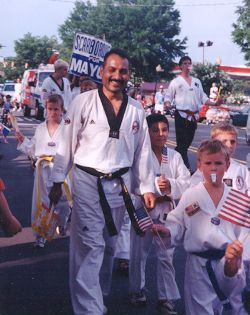
Now he wants to have schools on two continents. He plans to live and keep his school , in the United States, while
building and mentoring the school in India. "Just like two families, " he says. "Taking care of two families..."
He plans to build the school in a remote area of India where he owns land, rather than in Delhi where he established his
first school. He says he wants to work with students that understand commitment, devotion, honesty, and hard work.
If people have to make an effort to attend the school, he theorizes, they will be more likely to be dedicated to it.
And although he still plans to accept students who can't pay, he will require that they work in return for their
instruction. He found that in India, a more socialistic country than America, people often expect the government
or some other entity to provide for them. But he thinks that people gain more from training when they give something
for what they get.
Right now he sees his new Indian school as a puzzle. He is gradually trying to put the pieces together, especially
the financial pieces. He obtained a loan to get his North Carolina school started and he needs to make sure it is
on solid financial ground to insure its continued operation. Whenever possible, he has been talking to masters and
grandmasters to get ideas on how to best proceed.
The purpose of his efforts is to keep martial arts alive in both families, to "…keep the light on, not extinguish
the candle…"
|